
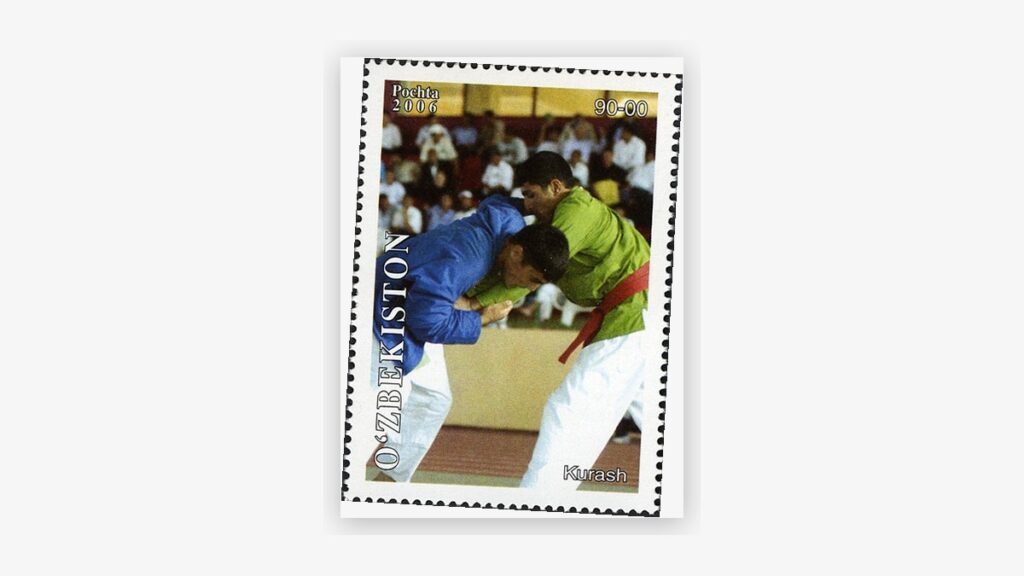
Kurash is a traditional form of upright jacket wrestling that originated in the territory of modern Uzbekistan. It is one of the oldest surviving grappling disciplines in the world, now governed by the International Kurash Association (IKA) with national federations across five continents.
Origin and history
The origins of Kurash reach back at least three and a half thousand years. It is mentioned by Herodotus, in the Uzbek epic Alpomish, and in the works of Avicenna. For most of its history it was a festival practice, performed at weddings and public gatherings, with rules passed on orally.
The name is commonly translated as “reaching the goal in a just and fair way”.
A unified competitive rule set — weight and age categories, fixed bout duration, standard uniforms and Uzbek terminology — was established in the twentieth century. The International Kurash Association was founded in Tashkent on 6 September 1998, and the first World Championship took place there in 1999 with 48 countries.
Rules
Kurash is contested exclusively in the standing position. Groundwork is not permitted: once a contestant goes down, the athletes are returned to standing. Only throws and leg sweeps are allowed; armlocks, chokes, strikes and grips below the belt are forbidden.
Senior bouts last four minutes for men and three minutes for women, with shorter durations for younger and veteran age groups.
The scoring terminology is Uzbek and identical worldwide. Khalol is awarded for a decisive throw and ends the bout; Yonbosh and Chala are awarded for throws of decreasing quality. Tanbeh is a minor penalty, and Girrom results in disqualification.
This restriction to standing work is what most clearly separates Kurash from judo and sambo, and gives the sport its fast, continuous rhythm.
Equipment and arena
Contestants wear a yakhtak — a jacket cut 15 to 20 cm above the knee — together with trousers and a belt, one competitor in green and the other in blue.
Bouts take place on a gilam, a mat measuring between 10 × 10 m and 16 × 16 m. Within it the contest area ranges from 8 × 8 m to 14 × 14 m, surrounded by a three-metre safety zone.
Competitive landscape
Uzbekistan remains the leading nation, both as the home of the sport and its most successful competitor. Iran, Kazakhstan, Tajikistan, Turkmenistan and India have produced continental medallists, and the sport has expanded in Africa and the Americas since the 2010s.
Olympic and international status
Kurash is not an Olympic sport. It was recognised by the Olympic Council of Asia in 2003, appeared as a demonstration event at the 2006 Asian Games in Doha, and is now part of the official Asian Games programme. The IKA is a member of GAISF and applies the World Anti-Doping Code.
Scientific perspective
Because Kurash is fought entirely from standing, its physical demands differ from grappling styles that include groundwork. Performance depends on grip strength and endurance, dynamic postural control, explosive lower-limb power, and recovery between short high-intensity efforts.
The injury profile is shaped by the same rule: sustained submission pressure is absent, but landing forces and shoulder loading during throws remain significant. As in all weight-category combat sports, rapid pre-competition weight reduction is a recognised concern.
Notable facts
Kurash is among the very few sports whose official competition terminology is used worldwide in its original language rather than in translation. Khalol, Yonbosh, Chala and Girrom are spoken in the same form in Tashkent, Johannesburg and Santo Domingo.
Sources
International Kurash Association — kurash-ika.org
Olympic Council of Asia — ocasia.org
Cover image: postage stamp, Post of Uzbekistan (2006), public domain, via Wikimedia Commons